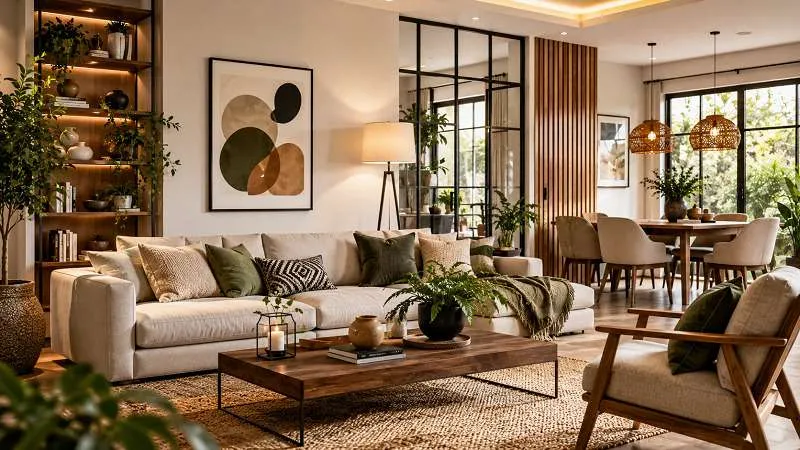
Some homes appear “done” the second the furniture goes in. Others improve with age. A chair you can tuck under a window. A work of art that transforms a hall. A stone surface that just looks better after 20 years of people walking on it. And the difference isn’t usually achieved by spending more. It’s achieved by making choices so carefully that the home is thoughtful, not just put together.
1.Consider a Residential Design That Responds to How You Actually Live
A family home in Richmond will be fundamentally different from a pied–terre in Battersea, despite the owners’ potentially similar attitudes toward style. Hence, a conceptualized interior design should begin with the way in which the property is occupied, identifying the gathering and storage areas, the lighting flows and functions. This is when residential interior design turns from a generic decoration to a specialized interior design.
That’s when residential interior design becomes about a more specialized task instead of simply being a decorating service. An experienced London Interior Designer will professionally coordinate key functional architectural factors to develop a high-performance spatial design.
Such factors may include the following:
- Bespoke joinery where storage is genuinely needed
- Furniture scaled to the architecture
- Materials that can withstand everyday use
- Color that responds to natural and electric light.
Professional residential interior designers recognize that in the case of period properties, the retention of character is often paramount, which allows for a more considered approach to the updating process.
2.Turnkey Design That Turns Good Ideas into a Cohesive, Real-World Interior
A stunning idea can be jettisoned in a flash when the reality of the work takes over. The material is marvelous on the mood board but just feels to frigid adjacent to the flooring; the artwork that packs a punch works against the lighting; and that piece of furniture looks simply wrong in the space.
That’s where turnkey interior design closes that gap by carrying the creative direction through every stage, from spatial planning and material selection to procurement, contractor coordination and final installation. The value is in the continuity. Rather than asking different suppliers to interpret separate parts of the design, one coordinated team keeps the original intention in view.
Materials are evaluated as a group: So stone, wood, metal, fabric and finish complement each other.
Decor and art are integrated into the design of the architecture and lighting design.
Joinery, furniture and storage are built around the way the space will be used.
For a domestic owner on a big renovation, or a foreign owner unable to be physically present on-site weekly, it really matters. What we’re after isn’t just a completed interior. It is to ensure that the completed interior remains a reflection of the space-driven concept that provided the rationale for the project to exist.
3.Online Personalized Design Breaks Limitations on Expertise Access
Not every project requires your designer to wander through your space with a tape measure. Maybe you’ve already decided what you want; all you need is to be shown how to connect the dots. That’s where online interior design for your space comes in.
You could also share pictures, video, measurements or a simple floor plan that you sketch out, and comparison pictures to give the designer an idea of your style. At this point, expert involvement allows your decisions a stronger platform. A scaled furniture plan might show your desired sofa is larger than you need, or a mood board might demonstrate how your selected finishes, colors and key pieces will truly coordinate.
The process may include:
- Space planning creating a comfortable furniture arrangement before you buy any furniture.
- Mood boards and 2D visuals to help you get a better understanding of what the desired direction.
- Furniture and sourcing lists that make the idea tangible as purchasing decisions.
- Designer amendments and ongoing support, so your scheme can grow through your comments.
This makes it especially effective when you desire to do the purchasing, decorating, or working with in the area of tradespersons yourself. You stay included, however no longer taking all the decisions on your own.
The designer offers expertise, thinking and a framework – and you provide the feel and functionality you’re looking for. Together, that can create a truly tailored online design service, rather than a one-size-fits-all offering delivered via a screen.
In essence, a curated home design is developed through listening and professional judgment. The best interiors don’t wear their effort on their sleeve. They feel right. That’s knowing how to create contrast, when to make it quiet, when to buy for longevity and when to let the homeowner’s own things tell the story.
Your home’s design, therefore, is less to do with filling space and everything to do with creating a point of view. With talented help, every decision supports the next, enabling the property to evolve over time rather than trying to keep up with the latest trend of the moment.